Tacos
One of the most common and widely recognized foods today is the taco. The taco has become an international phenomenon, and can be found all over the world. I chose the taco as my research project because I am very fond of tacos, and was interested in their history and place in our social world. Tacos are one of my favorite all-time foods, so I naturally felt drawn to the taco. I often prepare tacos at home, and my favorite type are ground beef tacos, topped off with lettuce, cheese, salsa, and sour cream. If I go out to a restaurant, I often have chicken tacos, topped off with cabbage, salsa, lime juice, and chipotle mayo. In this paper, I will explore the origins of the taco and how the taco has become another mass-produced fast food.
When Americans think of a taco, what often comes to mind is a fried corn shell stuffed with a spicy meat, shredded ice burg lettuce, sliced tomatoes, and grated cheddar cheese. The taco of today is vastly different from the original taco, which is thought to have been eaten by the Aztec people as early as 3000 BC (tacotoaster.com). The Aztecs used corn to make a “flat bread out of it and called it tlaxcalli” (tacotoaster.com). This flat bread was filled with various ingredients depending on the location of the people eating it. Aztec peoples who lived by lakes filled the flat bread with different types of fish, while the peoples who lived inland filled their flat breads with insects, ants, locusts, and snails (tacotoaster.com). The tlaxcalli was officially renamed the tortilla upon the arrival of Hernando Cortez and the Spanish conquistadors.
Today, the word taco is used generically much like the word sandwich. The Merriam-Webster.com dictionary defines a taco as a “usually fried tortilla that is folded or rolled and stuffed with a mixture (as of seasoned meat, cheese, and lettuce” (Merriam-Webster.com). There are many varieties of the taco, and location is usually an indication of the main type of taco found there. In the Southwest, especially New Mexico and Texas, the breakfast taco is found in many restaurants (whatscookingamerica.com). The breakfast taco is made from a “fried corn or flour tortilla that is rolled and stuffed with a mixture of seasoned meat, eggs, or cheese, and other ingredients such as onions and salsa” (whatscookingamerica.com). People living in San Diego are fans of the fish taco, which Ensenada, Mexico claimed to be the originator of. Fish tacos are “simply pieces of batter-coated, fried fish in a hot corn or wheat tortilla” (whatscookingamerica.com).
These examples of modern day US tacos are not very different from what is found in Mexico. Mexicans often wrap their choice of fillings in corn tortillas, and these tacos are eaten as snacks or as a dinner appetizer, but never as an entrée, unlike in the US, where the taco is consumed for lunch or dinner. Many Americans are surprised when they travel to Mexico and find that they cannot purchase a taco for certain hours during the day. Mexican tacos are often filled with “chili sauce, beef (ground or shredded), chicken, pork, chorizo, or sausage, egg, tomato, cheese, lettuce, guacamole, onions, and refried beans” (food.oregonstate.edu), similar to what is found in American tacos.
Tacos have also become part of the fast food revolution. This was made possible by the invention of “small-scale tortilla-making machines that could churn out hot, steaming tortillas every two seconds” (whatscookingamerica.com). Now, tortilla shells that had once been made by hand could be pre-fried, and “the shells could henceforth be mass-produced and shipped around the world, albeit with some breakage” (Pilcher 73). This new invention gave Glen Bell the tools he needed to found one of the most recognizable fast food restaurants in America, Taco Bell. After a successful run with various small restaurants that sold tacos, Glen and his partners built the first Taco Bell in Downey, California in 1962. In February of 1978, Glen Bell sold Taco Bell to PepsiCo for just “under $125 million in stock” (referenceforbusiness.com). PepsiCo began an aggressive campaign to challenge other leading fast food restaurants, by making “Taco Bell less of a regional ethnic food phenomenon and more a national fast food chain through Spartan simplicity in décor and menu, with a concentration on predictable quality, affordable prices, and clean and convenient surroundings” (referenceforbusiness.com). PepsiCo’s campaign was successful, and today Taco Bell is one of the most profitable and widely recognized fast food restaurants worldwide.
The tacos served today at Taco Bell are a far cry from the tacos that were first consumed in Mexico. Taco Bell tacos have undergone a standardization, “replacing the endless variety of local cuisines with the artificial choice of numbered selections from a value menu” (Pilcher 73). Tacos were now listed under the convenient category, and these “so called convenience foods became synonymous with saving effort, time, and money and with ending the drudgery of home cookery” (Haden 345). What could possibly be more American than having convenient foods available in every neighborhood, enabling an ever-faster pace of life?
While the tortilla making machines allow mass quantities of tortillas to be produced, it is corn that keeps their prices low and allows fast food restaurants such as Taco Bell to sell tacos cheaply and still make profit. Corn has become a cheap substitute for just about everything, and it is found not only in the tortillas, but was probably fed to the cattle that would become the taco meat and produced the milk for the taco cheese. Corn is also a key ingredient in the soft drinks that are sold at fast food restaurants. Since there is so much corn, and it is so cheap, “the smart thing to do with all that surplus grain is to process it, transform the cheap commodity into a value-added consumer product – a denser and more durable package of calories” (Pollan 103). This is exactly what fast food restaurants have done with the taco.
Tuesday, June 10, 2008

Monday, May 26, 2008
yumm, soup
I have to admit, when I found out the soup that we were going to make in class was vegan, I didn’t think it would be any good. So imagine my surprise when I tried the soup, and I discovered that it was awesome! The wine gave the soup a pleasant taste, and the vegetables were just delightful. I have decided to make this soup at home, and let the soup cook the full time that the recipe calls for, as we were running out of time in class and couldn’t allow the soup to simmer as long.
I have always enjoyed making soups, as I find them to be a comfort food. Soup is really easy to make, and can be a wonderful way to use any vegetables or leftover meats that may be hanging out in ones refrigerator. One of my favorite soups to make is vegetable soup – simple, basic, and delicious! To begin with, I chop up any vegetables I have on hand – including but not limited to: zucchini, celery, tomatoes, cabbage, carrots, potatoes, and onions. I usually sauté the carrots, celery, and onions in a bit of oil, and then add in chicken or vegetable stock. I bring this to a boil, and then add the rest of the vegetables. I also usually add a can of diced tomatoes with the juice to help flavor the soup. I then allow the soup to cook for a while, and then add in some sort of small noodle. Then, after allowing the noodles to cook for just a few moments, I serve the soup with a hot, crusty loaf of French bread and cold butter. MMMmmmmm!
I have always enjoyed making soups, as I find them to be a comfort food. Soup is really easy to make, and can be a wonderful way to use any vegetables or leftover meats that may be hanging out in ones refrigerator. One of my favorite soups to make is vegetable soup – simple, basic, and delicious! To begin with, I chop up any vegetables I have on hand – including but not limited to: zucchini, celery, tomatoes, cabbage, carrots, potatoes, and onions. I usually sauté the carrots, celery, and onions in a bit of oil, and then add in chicken or vegetable stock. I bring this to a boil, and then add the rest of the vegetables. I also usually add a can of diced tomatoes with the juice to help flavor the soup. I then allow the soup to cook for a while, and then add in some sort of small noodle. Then, after allowing the noodles to cook for just a few moments, I serve the soup with a hot, crusty loaf of French bread and cold butter. MMMmmmmm!
Choices, choices
I like meat… what can I say? I have always enjoyed a big juicy steak, or a tender chicken breast, or even a roasted turkey at Thanksgiving. I don’t think I could ever give up eating meat, even after reading Pollan’s discussion of killing animals for food.
I have always been one of the people who think it is easier to not think about where my food comes from. Taking this class has made me rethink that it is important to know where one’s food is coming from. While I would never be able to actually kill an animal myself (I can’t even kill a spider), I do think it is important that animals that are going to be used for food should be treated with dignity and respect during their lives. When animals are not treated humanely, it is a reflection on human nature, and shows us just how cruel we can be.
One thing I have always had a problem with is the superiority attitudes that vegetarians take on. After announcing that they don’t eat meat, they look at the person who does eat meat as if they are the scum of the world. I remember my sisters best friend would lecture on and on about how it was cruel to eat meat and how she was a better and healthier person for not eating meat. Then, one day when she was over at my house watching me cook dinner and telling me what a bad person I was for eating meat, I happened to look down at her boots. The boots reached to over her knees, and were made of good old fashioned leather. I started laughing, and told her that I thought she was a hypocrite – she wouldn’t eat meat, but she would WEAR animal skin? To me, that made absolutely no sense. My attitude has always been, I respect what you choose to eat (or not eat), and I expect the same respect back.
While I will continue to eat meat, I have decided to start buying and shopping for my meat differently. I have decided that I will search out a local source of meat, and start buying my meat from that source, instead of a grocery store. And while I do not condone hunting just for sport and pleasure, I would never think less of a hunter who hunts for food, and respects the animals that he kills. I believe this is the key to ethically killing and eating animals, treating them well in life, and making their death as quick and painless as possible.
I have always been one of the people who think it is easier to not think about where my food comes from. Taking this class has made me rethink that it is important to know where one’s food is coming from. While I would never be able to actually kill an animal myself (I can’t even kill a spider), I do think it is important that animals that are going to be used for food should be treated with dignity and respect during their lives. When animals are not treated humanely, it is a reflection on human nature, and shows us just how cruel we can be.
One thing I have always had a problem with is the superiority attitudes that vegetarians take on. After announcing that they don’t eat meat, they look at the person who does eat meat as if they are the scum of the world. I remember my sisters best friend would lecture on and on about how it was cruel to eat meat and how she was a better and healthier person for not eating meat. Then, one day when she was over at my house watching me cook dinner and telling me what a bad person I was for eating meat, I happened to look down at her boots. The boots reached to over her knees, and were made of good old fashioned leather. I started laughing, and told her that I thought she was a hypocrite – she wouldn’t eat meat, but she would WEAR animal skin? To me, that made absolutely no sense. My attitude has always been, I respect what you choose to eat (or not eat), and I expect the same respect back.
While I will continue to eat meat, I have decided to start buying and shopping for my meat differently. I have decided that I will search out a local source of meat, and start buying my meat from that source, instead of a grocery store. And while I do not condone hunting just for sport and pleasure, I would never think less of a hunter who hunts for food, and respects the animals that he kills. I believe this is the key to ethically killing and eating animals, treating them well in life, and making their death as quick and painless as possible.
Sunday, May 18, 2008
****Is Ignorance Bliss?****
Reading Michael Pollan's book, The Omnivore Dilemma, I find myself starting to become truly grossed out by processed food. I was absolutely shocked to discover that corn is in almost everything that is processed and eaten by Americans today. I was also horrified to learn about CAFOs, or Concentrated Animal Feeding Operations. I always knew that food animals weren't treated great, but I didn't realize the true extent of their torture until reading this book. I know that I don't want to give up eating meat, therefore I have decided to start buying free range and grass fed meat products. While I realize that large warehouses full of food animals, such as free range chickens who are kept inside for the first six weeks of their lives, and then allowed access to a tiny piece of grass this is not necessarily an ideal setting for food animals, at least I know that these animals are being treated a little better than other food animals. All I want is that animals who will be used for food to be treated humanely. To me, I feel that the best option for domestic food animals are to be raised on small farms and fed what the animals have evolved to eat. Antibiotics would be used only when the animal was sick, and slaughter would happen quickly and with the least amount of pain as possible.
I guess what has surprised me the most is the reaction I get when I talk to people who are not in my Anthropology of Food class about these issues. Hearing about corn taking over the supermarkets and ill-treated food animals really makes people uncomfortable. My husband told me that he would just rather not know this information (which surprised me, because my husband is an extremely intelligent man and usually absorbs all sorts of information like a sponge). My friends just completely changed the subject, choosing to ignore the truth. They say something along the line of isn't it just easier not to know all that?
I guess it really is easier to just not know where our food comes from. Its a lot easier to think of food animals roaming around on a farm in a beautiful green pasture - although this couldn't be further from the truth. I found myself wondering why it makes people so uncomfortable to know where their food comes from.... because obviously it just doesn't magically make itself!
Just as in the movie the Matrix, I find myself awakening to the truth of the world, as if I had taken the blue pill. However, I find that most people have already taken the red pill, which allows them to continue on in their own little perfect worlds, where they never have to really open their eyes and confront the harsh realities of what is going on around them. I guess in this way, that ignorance of the truth is truly bliss.
I guess what has surprised me the most is the reaction I get when I talk to people who are not in my Anthropology of Food class about these issues. Hearing about corn taking over the supermarkets and ill-treated food animals really makes people uncomfortable. My husband told me that he would just rather not know this information (which surprised me, because my husband is an extremely intelligent man and usually absorbs all sorts of information like a sponge). My friends just completely changed the subject, choosing to ignore the truth. They say something along the line of isn't it just easier not to know all that?
I guess it really is easier to just not know where our food comes from. Its a lot easier to think of food animals roaming around on a farm in a beautiful green pasture - although this couldn't be further from the truth. I found myself wondering why it makes people so uncomfortable to know where their food comes from.... because obviously it just doesn't magically make itself!
Just as in the movie the Matrix, I find myself awakening to the truth of the world, as if I had taken the blue pill. However, I find that most people have already taken the red pill, which allows them to continue on in their own little perfect worlds, where they never have to really open their eyes and confront the harsh realities of what is going on around them. I guess in this way, that ignorance of the truth is truly bliss.
****MMMMMMmmmmmmm****
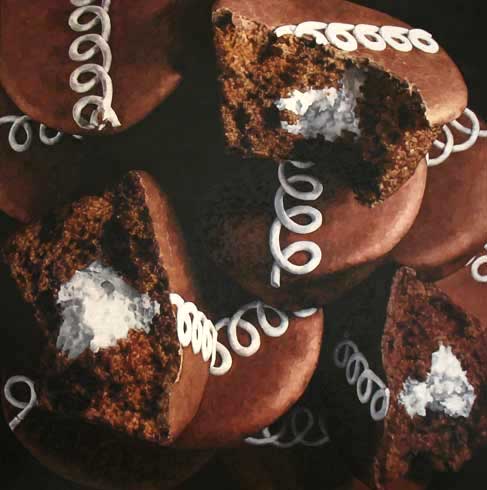
Ever since I was a little girl, I always remember loving Hostess Cupcakes. I just can't resist them, with their sweet creamy center and moist chocolate cake. I know I shouldn't eat them, but I just can't help myself.
When I was younger, my mother would buy a box of 8 Hostess Cupcakes for the week. I would try and ignore them, pretending they weren't there, but I would hear the Cupcakes calling my name...."come eat me, I'm sooooo good!" And any sense of self-control I had would be out the window, and I would find myself indulging in the Cupcake. The only problem was, once I ate the first Cupcake, it was like I opened Pandora's Box.... I would go into something that could only be described as a feeding frenzy. I would eat the entire box of Cupcakes in less than an hour! Afterwords, I would always feel guilty, especially when my mother would discover that I had eaten the entire box!
When I discovered that Hostess had recently started making 100 calorie packs of their Cupcakes, I got excited. I bought a box, and I thought since I am older and wiser, that I would be able to control myself, and just eat one package of the cupcakes..... WRONG! I soon found myself devouring the entire box of the 100 calorie Cupcakes. I knew right then and there that I should never again buy the box of 100 calorie Cupcakes, because I still couldn't control myself.
Now, when I really get the urge to have a Hostess Cupcake, I purchase the individual 2 pack. I enjoy my treat, knowing that there is a limit to how much damage I can cause. I know I shouldn't eat the Cupcakes, as there is absolutely nothing natural or normal in the ingredients. I know that scientists figuring out what tastes like chocolate is"just one aspect of the technical information-gathering eneded to produce a growing range of chocolatized products" (Haden 354).
picture URL: www.pamelamichellejohnson.com/images/cupcakes.jpg
Sunday, May 11, 2008
Food Prices on the Move
On Thursday, our class had the opportunity to hear Raj Patel speak on the food issues that have recently begun to become worse in the world. It was really interesting to hear his opinions on why food prices have recently risen. His first reason was oil. This was interesting because so much of the food grown in the US depends on oil, either for shipping or growing. With the recent explosion of the price of a barrel of oil, I can see that food prices will continue to rise sharply. Raj's second reason was the bad harvests that have plagued various countries due to bad weather. Recently, anyone who even slightly pays attention to the news will have noticed the horrific weather that has been experienced worldwide. While the weather not only destroys crops, it displaces people who are often already very poor, and makes it even harder for these people to afford food. The third reason proposed by Raj about the rise of food is the recent demand for biofuels, especially ethanol. Ethanol is made from corn, and when more corn is being used for fuel, there is less corn for food. I predict that ethanol demand will eventually drop, considering the large amount of corn needed to make ethanol. The fourth reason for the rise of food according to Raj is the growth of developing countries such as India and China. As Raj said, with a growing middle class comes demands and desires, like wanting to eat. The final reason that Raj said that food prices are rising is due to the speculation that there is a food shortage and the prices are rising. When this happens, the general public starts to get worried and wants to store excess food. Food companies such as supermarkets take advantage of this public panic, and uses this as an excuse to raise food and increase their profits. I find this especially relevant as the US is not experiencing any food shortage, but stores such as Sams Club and Costco are limiting the amount of some rices that can be purchased.
2 Weddings & an Ethnicity
Growing up in an Irish family in Chicago, I was always exposed to basically the same foods. This was especially apparent at any wedding that I attended. There was always some variation of the Irish "basics": soup, salad, meat - often chicken or steak with varying sauces, a vegetable, and of course some form of potato. The main meal was followed up with a yummy dessert of wedding cake. Minor variations did occur, but the menu was usually pretty similar. I was never pushed out of my comfort zone, and had never left a wedding hungry (often the opposite, left way to full!).
My comfort zone was pushed to its ultimate outer edges when my husband and I moved to Seattle. As there is an extremely diverse population living out here, we made friends with people of other ethnicity's. My husband's office mate was a really nice Chinese man who grew up in Australia, and they became good friends. My husband's office mate had just gotten engaged and was in the middle of planning his wedding. We were invited to the wedding, and I became nervous about it when I discovered that it was going to be a traditional Chinese wedding. I had never had any experience with 'real' Chinese food, just the American versions which included chop suey, sweet and sour pork, egg rolls, and fortune cookies.
After a beautiful ceremony, everyone headed off to the restaurant for the reception. I immediately felt out of my comfort zone, as the table we were at, which was composed of my husbands co-workers and their wives, was the only non-Chinese table in the reception. There was a menu in the middle of the table, and reading it over, i recognized nothing!
When the first dish was brought out, I was relived. I recognized pieces of pork, and there was some form of 'noodle' sitting next to them. I poked the 'noodles' and asked what kind of 'noodles' were a clearish white. My table mates informed me that it was shredded octopus, and I knew I was in for a long night. My comfort level was tested at each of the 10 courses served, as each dish brought out was more strange and exotic than the previous. Goey-duck, shark fin soup, barnacles, and a whole fish complete with eyes were some of the courses served. I found myself extremely uncomfortable and out of place. I didn't want to insult my hosts by being disgusted, and I knew that the meal was really expensive. I picked at various things through the night, but ultimately left the reception still hungry.
This wedding made me acutely aware of the power of ethnicity in choice of food. Never before had I ever been exposed to such exotic foods, and it made me uncomfortable and pushed me outside my comfort zone.
My comfort zone was pushed to its ultimate outer edges when my husband and I moved to Seattle. As there is an extremely diverse population living out here, we made friends with people of other ethnicity's. My husband's office mate was a really nice Chinese man who grew up in Australia, and they became good friends. My husband's office mate had just gotten engaged and was in the middle of planning his wedding. We were invited to the wedding, and I became nervous about it when I discovered that it was going to be a traditional Chinese wedding. I had never had any experience with 'real' Chinese food, just the American versions which included chop suey, sweet and sour pork, egg rolls, and fortune cookies.
After a beautiful ceremony, everyone headed off to the restaurant for the reception. I immediately felt out of my comfort zone, as the table we were at, which was composed of my husbands co-workers and their wives, was the only non-Chinese table in the reception. There was a menu in the middle of the table, and reading it over, i recognized nothing!
When the first dish was brought out, I was relived. I recognized pieces of pork, and there was some form of 'noodle' sitting next to them. I poked the 'noodles' and asked what kind of 'noodles' were a clearish white. My table mates informed me that it was shredded octopus, and I knew I was in for a long night. My comfort level was tested at each of the 10 courses served, as each dish brought out was more strange and exotic than the previous. Goey-duck, shark fin soup, barnacles, and a whole fish complete with eyes were some of the courses served. I found myself extremely uncomfortable and out of place. I didn't want to insult my hosts by being disgusted, and I knew that the meal was really expensive. I picked at various things through the night, but ultimately left the reception still hungry.
This wedding made me acutely aware of the power of ethnicity in choice of food. Never before had I ever been exposed to such exotic foods, and it made me uncomfortable and pushed me outside my comfort zone.
Subscribe to:
Posts (Atom)
